Build your own XI: reading 4-3-3 and 4-2-3-1 formations
· 7 min read
On matchday, the lineups are announced and social media instantly turns everyone into a head coach. "Why is this player on the bench?", "Why not a back three?", "Nobody in midfield can carry the ball!" Everyone has an opinion; but it is not easy to test those opinions. Building your own starting XI and comparing it with the official lineup is both fun and one of the most direct ways to read football better.
This article offers two things. First, we explain what formation numbers mean and the difference between 4-3-3 and 4-2-3-1, the two most common formations. Then we show, step by step, how to build your own XI in TacticIQ and what to watch for while doing it.
What do formation numbers mean?
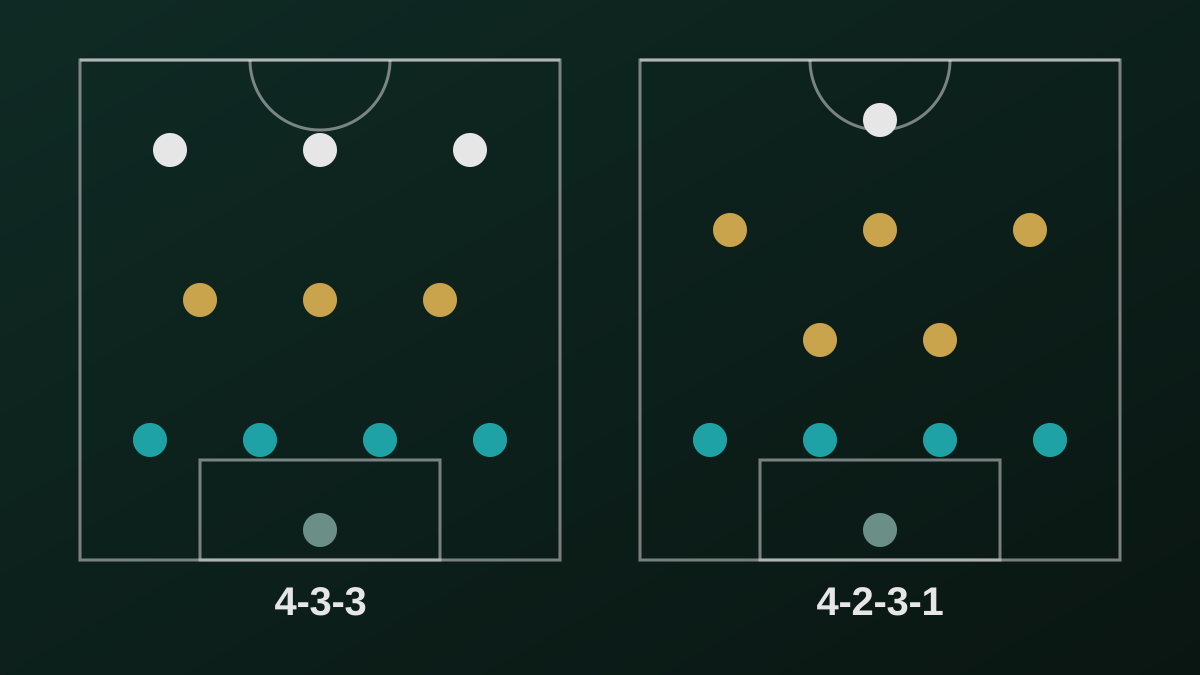
When we write a formation as "4-3-3," we divide the ten outfield players, from back to front, into three lines: four defenders, three midfielders and three forwards. Ten in total; with the goalkeeper, that makes eleven.
The numbers show the positional order on the pitch, not the players' duties. Within the same 4-3-3, one team's wingers may drop back and defend like a six, while another team's wingers may cut inside and attack like forwards. So when reading a formation, ask these three questions:
- How many players are in the defensive line, and how high do the full-backs push?
- In midfield, how many are ball-winners and how many are creators?
- In attack, is there a single central forward, two forwards, or a wide front three?
4-3-3: width and midfield balance
Four defenders, three midfielders and three attackers. The attacking line has a central forward and two wingers.
Strengths:
- Width comes naturally from two players on the wings.
- The midfield trio supports possession play and a quick pressing exit.
- Having three attackers creates constant multiple options against the opponent's defence.
Weaknesses:
- The midfield is limited to three players; if the opponent plays with four in midfield, a numerical disadvantage can arise.
- If the wingers do not drop back enough to defend, the full-backs are left alone.
How to read it: If the midfield trio has one deep (holding) player and two advanced midfielders, the team is more attack-oriented. If it has two holding players and one creator, the team is more balanced and cautious.
4-2-3-1: double pivot and the number ten
Four defenders, two deep midfielders, an attacking midfielder (the "number ten"), two wingers and a single striker. On paper it is a one-striker setup; on the pitch, the number ten moving up close to the striker can make it look like a two-striker formation.
Strengths:
- Two deep midfielders form a solid screen in front of the defensive line, giving cover during transitions and turnovers.
- The player behind the lone striker finds space between the lines and increases creativity.
- When both wingers help in midfield when defending, the structure often becomes a solid 4-4-1-1.
Weaknesses:
- A lone striker can be isolated against the opponent's two centre-backs.
- The wingers and number ten have to create the difference with their individual qualities.
How to read it: On the team sheet a side listed as 4-2-3-1 is defined in practice by the shape it takes when defending and the positions of its full-backs when attacking. If one full-back pushes very high, a back three can effectively form in practice.
4-3-3 or 4-2-3-1? A short comparison
| Topic | 4-3-3 | 4-2-3-1 |
|---|---|---|
| Midfield | Three players, more balanced | Double pivot + number ten |
| Attack | Three forwards, wide | Single striker, supported |
| Defensive cover | Medium | Strong, double screen |
| Width | Comes naturally from the wings | Provided by wingers and full-backs |
| Use of counter-attacks | Possible with fast wingers | Long ball to the striker and support from the number ten |
What matters is not which one is "better," but whether it suits the players. A team with three good midfielders leans toward 4-3-3; a team with two solid pivots and a good number ten leans toward 4-2-3-1. And most teams switch between these two shapes during a match.
How do you interpret a probable XI before the match?
To make predictions before the official lineup is announced, look at these clues:
- Squad continuity in recent matches: Does the head coach change the squad a lot, or keep a core?
- Absences and suspensions: The injury and suspension list solves half the puzzle. If a player is missing, think about who will fill that position. (The injured and suspended players are shown on the team page in TacticIQ.)
- Fixture congestion: If there are matches played at short intervals, rotation is expected.
- The opponent's structure: If the opponent is wing-based, think about who will track back to cover the wings and the full-backs.
- The head coach's habits: Some head coaches keep their formation fixed in big matches, others change it according to the opponent.
Here the aim is not only to make an accurate prediction, but also to be able to explain to yourself why you made that prediction. This habit develops football intelligence.
How do you build your own XI in TacticIQ?
- Open the match. Choose an upcoming match from the home page and go to the Lineup tab.
- Choose the formation. In the app you can choose among different formations. Some advanced options, such as the defensive shape selection, may change depending on the plan; you can see the current scope in the app.
- Place the players. Use the selector to put players in their positions. Add them with "Add to Squad" and confirm when complete.
- When you confirm, move to the Prediction tab. Once your squad prediction is confirmed, the app takes you to the player and match predictions.
- Compare after the match. When the official lineup is announced, the players and formation you placed correctly appear as separate items in the scoring section: squad points per player, and formation exact match or similarity.
Two rules to watch
- Time bonus: Predictions made before the official lineup is announced earn a time bonus, while a slight decrease applies to those made in the last two hours. So early analysis is rewarded.
- Lock: Once you see the official formation, your squad and prediction changes for that match are locked. The app asks you in advance: "If you see the official formation, the prediction and squad changes for this match will be locked. Do you want to continue?" Save your own XI first, then look at the real lineup.
Also, in some leagues the data provider may not publish the formation at all; in such cases the app shows "Formation data could not be provided." This is not an error, but a limit of the source.
Common mistakes when building your own XI
- Star bias: Putting a player you like on the pitch even if he is not in form. Build your squad with the data from recent matches, not your heart.
- Position confusion: A player listed as "midfielder" on paper does not mean he plays the same role as on the team. Look at where he has played in the last few matches.
- Forgetting the opponent: Not thinking about the opposing wings when building your own formation.
- Ignoring rotation: It is normal for a team that played a tough match a few days earlier to change its squad.
Conclusion
A formation is not a diagram, but a statement of intent. Reading the numbers is the first step to understanding that intent. As you build your own XI and compare it with reality, you will see clearly which of your instincts work and which mislead you. After a while, when the lineup is announced, instead of being surprised you will be able to say "I had predicted this" or "why couldn't I see this?"