Halftime or full time? Predicting score, goals and tempo
· 5 min read
When we think of predicting a match, most of us think of a single score. But football is not a single 90-minute event; it is a story made up of two halves, several tempo changes and usually three or five critical moments. That is why the prediction tab in TacticIQ breaks a match down into several questions: halftime score, halftime result, full-time score, total goals and first goal time. In this article we explain why these questions should be considered separately, and how reading tempo helps.
Halftime and full time are not the same question
A common mistake is to see a halftime prediction as half of a full-time prediction. Three real reasons show why the two must be separated:
- The structure of tempo: In many matches, teams feel each other out in the first half and the tempo rises in the second. In some matches, the opposite happens: an early goal comes and the side ahead retreats.
- Changes in the game plan: At half-time, the coaching staff can make changes, and one side's pressing height can drop. Dominance in the first half may not continue in the same way in the second.
- Fatigue and substitutions: The final 20 minutes of the second half are a different match; new players come on, legs tire, and spaces grow.
So a pair such as "0-0 at halftime, 2-1 at full time" must be internally consistent: if you expect a closed first half, you should also think about which event will break the balance for the full-time score. TacticIQ records your predictions separately, so when you look back at your history you may notice a pattern such as "I read the first half well, but I set up the finish wrongly."
Total goals: not a number, but tempo
A total goals prediction is not a score prediction; it is a tempo prediction. By looking at how the teams will play, you can gather three hints:
Pressing height
If two teams that press high in the opponent's half meet, the ball is lost near the goal and the number of chances rises. In a match where both sides wait in a mid-block, expecting few goals is logical. We explained the details of watching pressing in our tactics guide.
Transition defence
A team whose full-backs are high and whose midfield is open is more prone to conceding on the counter. Whether the opponent produces fast exits directly affects the total goals prediction.
Quality of positions
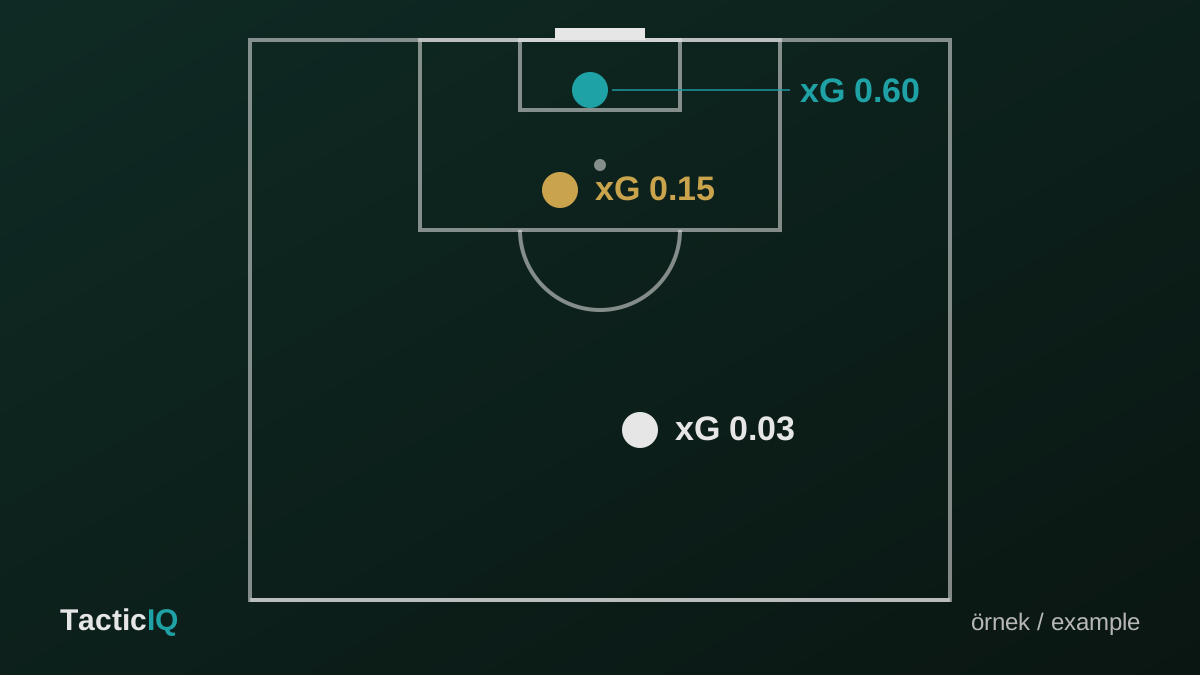
Shot count alone is misleading. Finishing with a few clear chances is worth more than ten shots from distance. Expected goals (xG) measures exactly this; you can find the details in our xG article. In the app, the xG row appears only when the data provider sends it; it may not appear for every match. So don't rely on a single data point in your prediction.
When predicting, think in ranges rather than exact numbers: saying "this match will have two or three goals" is a more honest reading than saying "exactly two goals." In the app, exact hits and close ranges are scored differently for total goals; so a small deviation does not go entirely to waste.
First goal time: look at the opening ten minutes
The first goal time category pushes you to watch the first 10-15 minutes of the match. In this window, look at:
- Do the teams start the match aggressively, or do they pass the ball around?
- Are the goalkeepers busy in the early minutes?
- Does a team usually start slowly or quickly in its previous matches?
A general rule: if both teams are playing a cautious plan, the first goal tends to come later; if there is high pressing and open play, an early goal is more likely. However, in football a single set piece or an individual error can break the whole plan. So it is healthier to think of the first goal time within a wide window than to tie it to one specific minute.
Think in scenarios
Good predictors do not read a match as one definite story, but as several possible scenarios. Before submitting, write three scenarios:
- Early goal scenario: Does the side ahead retreat, or does the side behind press to build pressure?
- Closed first half scenario: Which team makes the first move in the second half?
- Late chaos scenario: How do the substitutes and fatigue shape the last 20 minutes?
Chain your scenarios together; that is, connect them with the logic that "if they all turn out right together." Each prediction must stand on its own football logic. An unrelated pile of predictions weakens both your points and your learning.
Short pre-match checklist
- Are there injured or suspended players? (The app may not show this information for every match; verify it from a source you trust.)
- How did the teams start their recent matches: early or late?
- Is the match in the middle of the week, and is a team playing a congested fixture schedule? Fatigue affects the second half.
- Is this match "very important" for one team? Big matches usually start cautiously.
- Do conditions such as weather and pitch affect the tempo?
How do you evaluate your predictions?
When looking back at your prediction history, ask these questions:
- Am I more accurate in halftime predictions, or in full-time predictions?
- Do I always say "many goals" in my total goals predictions? If so, am I over-rewarding attacking play?
- Do I usually set the first goal time early or late?
These questions take you away from the debate about "luck" and toward an analysis of "habit." If you see that your mistakes follow a pattern, correcting that one pattern in your next match will raise your points even by itself.
Conclusion
Halftime, full time, total goals and first goal time measure different skills. One helps you read tempo, another the game plan, another individual moments. Don't approach every question with the same mindset; gather the clue each one needs separately. TacticIQ is a no-betting game, so the goal here is not to make money but to read football better. Asking "which clue did I miss?" after every match makes a real difference over time.